
Research Areas
Cutting-edge research in wireless systems, networks, and communications
Ongoing Research
5G/6G Networks
Research on next-generation cellular networks including 5G and beyond 5G technologies.
5G/ORAN Resiliency
O-RAN resiliency is the ability of an Open Radio Access Network to maintain reliable and predictable service even when parts of the system face failures, overloads, misconfigurations, or other disruptions. It is achieved through a combination of architectural design, redundancy strategies, automation, and intelligent control, rather than a single mechanism. As 5G networks evolve toward 6G, meeting stringent Service Level Agreements (SLAs) becomes increasingly challenging, making fault-tolerant networks more critical than ever. O-RAN’s softwarized architecture enables self-healing capabilities, and the integration of AI and machine learning within Near-Real-Time and Non-Real-Time RAN Intelligent Controllers allows networks to proactively detect issues, optimize performance, and recover from faults with minimal human intervention.
5G: Network softwarization
Recently, network operators and data centres have moved towards virtualization..
Agentic Systems for O-RAN
An agentic system is a technological framework often powered by artificial intelligence in which an "agent" (such as an AI model or software entity) operates autonomously to pursue complex, multi-step goals on a user's behalf. Unlike standard chatbots that merely generate text, agentic systems can perceive their environment, reason through tasks, make decisions, and execute actions by using external tools and APIs to achieve a specific objective .
LLMs for Networking
A Large Language Model (LLM) is a type of artificial intelligence trained on massive amounts of text data to understand, generate, and manipulate human language. By analyzing patterns, context, and relationships between words, LLMs can perform a wide range of task such as answering questions, writing content, summarizing text, translating languages, and even generating code based on a given prompt or instruction.
Network Security
Network Security remains a fundamental challenge across both traditional and next-generation communication networks. It encompasses an adversary's ability to seize control of, intercept, or disrupt critical network services, either by exploiting architectural design vulnerabilities or by leveraging implementation gaps in deployed systems. Such adversaries range from individual threat actors to sophisticated, state-sponsored organizations that intend to compromise system integrity, availability, or confidentiality.
Networks for XR
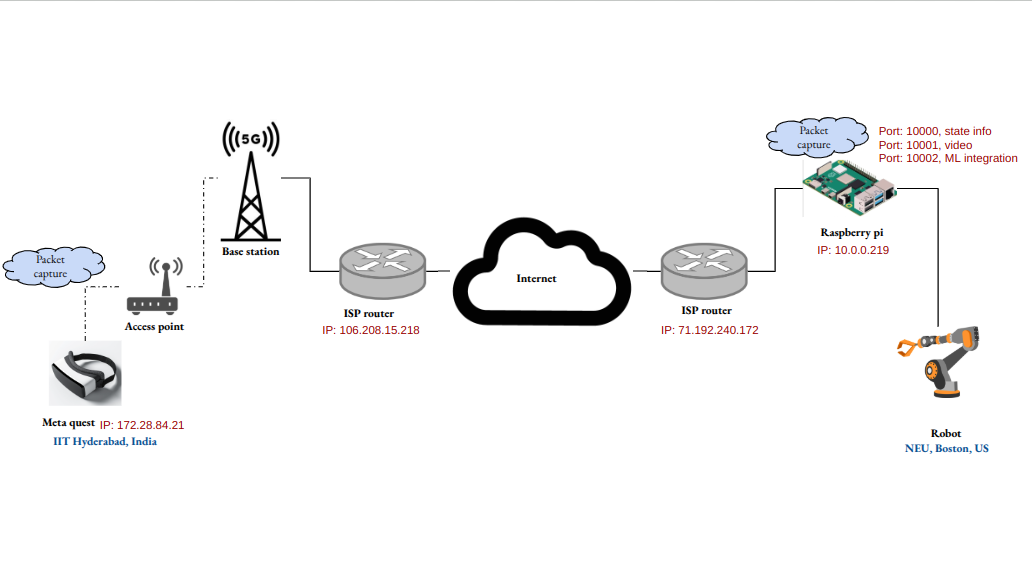
Our research focuses on next-generation XR-enabled teleoperation systems that integrate robotics, communication networks, digital twins, and edge computing to enable immersive, ultra-low-latency remote interaction. We investigate the networking challenges associated with meeting the stringent requirements of XR-based teleoperation and explore cross-layer architectures to jointly optimize control stability, network performance, digital twin synchronization, and Quality-of-Interaction (QoI). Our goal is to design scalable and reliable real-time remote manipulation and telepresence systems that deliver enhanced user experience.
Software Defined Networks (SDN)
Exploring programmable network architectures and centralized control planes.
WiFi Security
Working on WPA3 Downgrade Attacks in scenarios where APs are set in WPA3/2 transition mode or WPA3 only mode.
Past Research
5G: Multi-access Edge Computing
5G expected to deliver data in the order of Gbps and end-to-end latency in order of few..
AI for Cyber Security
AI will continuously learn and adapt to the latest threat knowledge to mitigate evergrowing cyber security attacks.
Bare-metal as a Service Cloud Computing
Bare-metal as a Service cloud - the private cloud behind the screens, now coming to the stage.
Converged Cloud RAN
Cloud RAN (C-RAN) is a novel radio access network (RAN) architecture for cellular networks which has potential.
DNS/IPv6 for IoT Security
This project is being funded by NASSCOM-CoE on IoT. It's in collaboration with ICANN/NASSCOM
Intelligent Transportation Systems
Intelligent Transportation System aims at providing smarter and safer transport and traffic ..
Internet of Things (IoT)
Connected devices and smart systems for various applications.
LTE and Wi-Fi Interworking
Demand from data hungry applications in smartphones/tablets brings a significant traffic load onto mobile networks.
LTE-U/LAA and Wi-Fi Coexistence
Due to the surge in usage of smartphones and tablets, there is an ever increasing demand for mobile data.
Machine to Machine Communications
Internet of Things (IoT) is a paradigm whose aim is to implement the concept of interconnection of everything by using all..
Small Cell Networks
Presently, cellular network users are not only those which generate mostly downlink traffic..